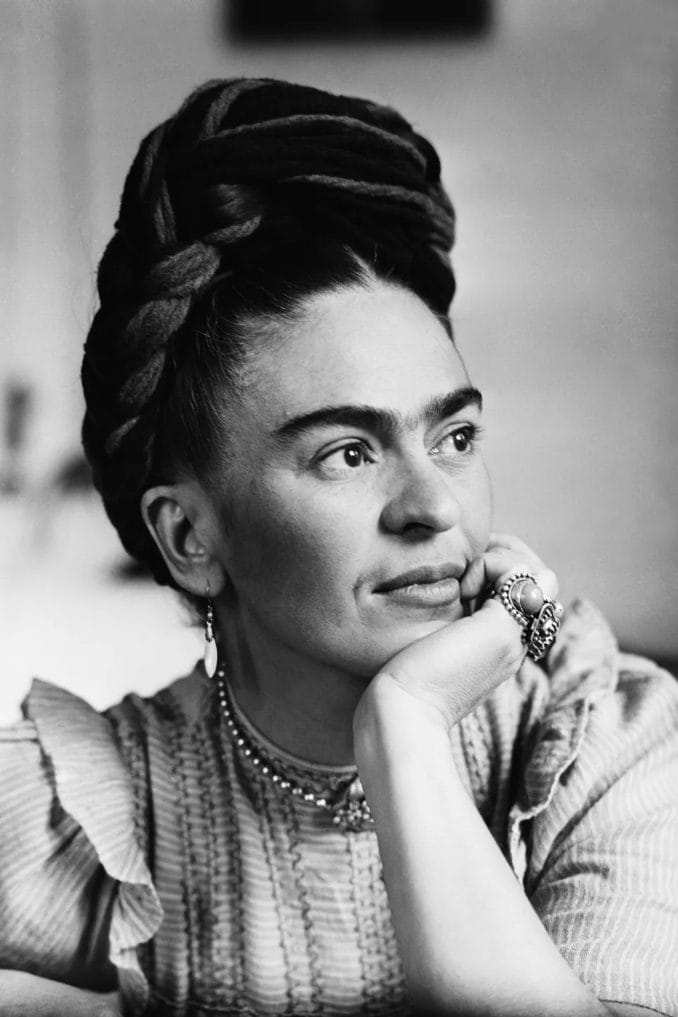
Between stolen moments and moments of grace in the sun-drenched Casa Azul in Mexico, a look back at the most beautiful shots of the inspiring Frida Kahlo.
“I love this courageous painter who overcame her handicap by painting, many portraits of herself. Her paintings breathe Mexico with their vivid, shimmering colors. A crazy personality and charisma!”
She is one of the greatest artists of the 20th century. Frida Kahlo is the mysterious, elegant, passionate woman who made freedom her lifeline. In 1928, she was just recovering from the accident that had injured her spine and legs three years earlier, when she met the man of her life, Diego Riviera. Forced to remain in bed for a long period, she produced a rich output of self-portraits, made with the aid of a mirror hung above her bed. Diego Rivera was immediately captivated by Frida’s paintings, which he described as inhabited by “a vital sensuality further enriched by a ruthless, yet sensitive faculty of observation.” Driven by their love of art, their deep attachment to their country and a shared revolutionary political commitment, they married in August 1929. Their union was punctuated by the immense success of both painters, their extensive travels, their encounters with the greatest artists of their time – Picasso, Breton, Kandinsky… – as well as extra-marital affairs, notably Rivera’s affair with his sister-in-law, which led to divorce, before the couple married again in 1940. They remained together until Frida Kahlo’s death in July 1954.
Deeply attached to her country, Frida Kahlo always saw herself as the voice of the oppressed. Before becoming a painter, Frida had wanted to become a doctor, as she had lost part of her right leg to poliomyelitis at the age of six, and wanted to help the sick. Unfortunately, fate had other plans: following a terrible accident on a bus (in which an iron bar pierced her leg), she underwent numerous surgical operations, was unable to leave her bed for many months and had to wear a corset for the rest of her life. She turned to painting, having acquired a solid artistic knowledge. Her work includes 55 self-portraits in which she expresses her suffering, her paintings becoming the mouthpiece for her pain.
Joining the Communist Party in 1928, she wished to defend the status of women and the emancipation of Mexican women in a macho society. She met the great love of her life, the painter Diego Rivera, twenty years her senior, but their union remained very open, Frida not hesitating to flaunt her bisexuality and Diego cheating on her.
Diego Riviera and Frida Kahlo by Wallace Marly (left) then by Bettmann
A true beauty icon
In Mexico, she is a true icon of beauty, despite her sometimes unkempt appearance.
A strong, avant-garde woman, a muse, a model of commitment for many women. It’s no coincidence that she has become a source of inspiration for many artists and stylists.
“Wedding Portraits of Frida Kahlo and Diego Rivera,” by Victor Reyes, 1929. Photograph, vintage gelatin-silver print, with hand-applied transparent watercolor. Museum of Fine Arts, Boston.
Frida‘s work is imbued with Mexican culture and her love of nature. A visionary, she was the image and voice of her country. Although classified as a surrealist, Frida defined her work not as the product of her dreams, but as the result of her life itself, a meeting of fantasy and realism.
Trapped in a corset throughout her life, Frida Kahlo, a free and modern woman, created an autobiographical work of exceptional power and originality, using art as a catharsis mechanism.
“The Two Fridas” or “Double Self-Portrait” was painted in 1939, following her separation from her husband Diego Rivera. Kahlo’s separation from her husband plunged her into deep distress. In this painting, Frida Kahlo depicts two Fridas holding hands, but with different attitudes and physical appearances.
On the left, the artist is elegantly dressed in a traditional white wedding dress. She is wearing make-up and standing up straight. On her chest, her heart is clearly visible, exposed outside her body by a tear, with two veins visible. The dress is stained with blood from a vein. On the right, the artist is wearing a Tehuana, a traditional Mexican dress. Her face is colorful, with no makeup. Her stance (legs apart) and visible moustache give her a masculine look. Her heart is intact. An artery links the two Fridas, with the one on the left kept alive by the one on the right. This painting is an attempt by the artist to reconnect and reconcile with herself following her break-up.
Frida Kahlo by Ivan Dmitri
Frida Kahlo, self-portrait in velvet dress, 1926, oil on canvas – Private collection.
“So absurd and ephemeral is our passage through this world, that the only thing that reassures me is the awareness of having been authentic… Of being the most like myself that I could have imagined.” Frida Kahlo
She depicts herself using a mirror to capture her reflection, and this work, inspired by Parmesan and Modigliani, marks the start of her career.
Frida Kahlo’s painting “Self-Portrait with Thorn Necklace and Hummingbird”, painted in 1940, is one of the artist’s best-known works. This major work depicts the artist in full frontal view, surrounded by a monkey on her right and a black cat on her left.
She wears a necklace of thorns that pierce her neck and draw a few drops of blood, from which hangs a dead hummingbird. The artist is dressed in traditional Mexican garb. The painting is in the collections of the Museum of Fine Arts, Boston.
What is the meaning of this painting? Frida wanted to depict the pain of her separation from the painter Diego Rivera. The two artists divorced in 1938 and remarried in December 1940. This divorce was very hard for Kahlo, who painted several pictures on the theme of heartbreak. The hummingbird (dead) represents luck, lost forever. The black cat, a sign of bad luck, tries to catch the bird, to eat it or hurt it further. The monkey, in Christian symbolism, is associated with the devil. The artist depicts her ex-husband, Diego, through the primate who is tying the thorn collar around her neck, in an attitude of indifference to the pain she is feeling.
Frida Kahlo and Jacqueline Lamba, Patzquaro, Mexico, 1930
Frida Kahlo, The Broken Column (1944)
The painting “The Broken Column” was created in 1944. This self-portrait shows the artist in full frontal view, standing in the middle of an arid, barren landscape, bare-chested and constricted by a white corset. The impression is disturbing and the painting is hard to look at. The artist’s body is strewn with numerous nails, split open to reveal a spine made of steel and broken in several places. Big tears flow from Kahlo’s eyes, whose gaze is fixed on the viewer.
Among Kahlo’s many self-portraits, this one is particularly powerful and moving. The pain emanating from the work is palpable, while the strength and pride that allow the artist to hold on are discernible. The work echoes the artist’s bus accident in 1925, when he was just 18, which left him with serious after-effects for the rest of his life. Although the work is full of symbols, Kahlo denies being a surrealist: she is not painting dreams, she is painting her life and her personal experiences, those of a suffering and broken woman who can only fight to live.
Frida Kahlo, “Self-portrait on the border between Mexico and the United States”.
Frida Kahlo in sari
“Fall in love with life, with yourself. And then, with whomever you want.” Frida Kahlo
Frida Kahlo’s blue house.
A place of creation, passions, parties and drama, this typical Mexican villa was a haven for all the free spirits of the ’30s. Frida welcomed Léon Trotski, André Breton and, of course, lived with Diego Rivera.
The place has become a must-see in Mexico. Now the Frida-Kahlo Museum, the Casa Azul (or Blue House) is located in the center of Coyoacán. This is where Frida was born and where she died in 1954. Her ashes rest on her bed, collected in an urn in the shape of her face.
Ms Trotsky, Frida Kahlo, Leon Trotsky and Schachtman
Brown hair adorned with red flowers, eyebrows that meet in the shape of black gull wings and traditional Mexican dresses… Seventy years after her death, the image of Frida Kahlo is more present than ever, and her work is frequently exhibited around the world. But beyond the pop and feminist icon, what should we remember about this 1920s artist? The eternal lover with a tumultuous life, Diego Rivera’s alter ego, her incredible vitality despite physical suffering and her existential relationship with painting?
Exceptional exhibition Frida Kahlo ¡Viva La Vida! at the Grand Palais Immersif in Paris, from September 18, 2024 to March 02, 2025.


Wonderful Artist 👍👏👏👌👌👌🥰🥰🥰
yes