Aboubakar Fofana is a Malian artist, textile designer, calligrapher, and master dyer, renowned for his work with natural indigo. An heir to ancestral West African craftsmanship, he dedicates his practice to rediscovering traditional plant-based dyeing techniques and fostering a dialogue between them and contemporary art.
“Les arbres à bleu” (Blue Trees), 2012, cotton sheets woven with Malian stripes, metal base, PVC tubes, loofah, sand
Through textiles, calligraphy, and installation art, he creates work where craftsmanship, spirituality, ecology, and contemporary creativity converge.
His artistic practice is grounded in the use of natural pigments, mineral muds, and textile fibers dyed using eco-friendly methods passed down through generations. Drawing inspiration from Islamic calligraphy, Sufi philosophy, and African traditions, Aboubakar Fofana transforms textiles into a space for meditation, where color, light, and time become essential elements of the work.
Exhibited in numerous international institutions, his work celebrates the memory of traditional know-how, the beauty of the artisan’s craft, and the profound bond between humanity and nature. “I want my work to become more sensitive and better attuned to the needs of Black diaspora communities and the lands we inhabit—specifically regarding the restoration of ancestral culture, plant-based medicine, and emancipation.”
From cultivation to fiber, from fabric to art, Aboubakar Fofana’s journey toward mastering indigo is exceptional. Drawing inspiration from ancestral West African natural dyeing techniques, each of his creations aims to promote the health of both humanity and the earth through the healing properties of pure indigo. The result is a body of artworks and installations that reflect the twelve shades of blue found in cosmology.
Dried ngalama leaves are prepared for dyeing; the indigo compost is then mixed with a solution of water and millet ash, and the mixture is gently stirred day after day.
Textile installation in the Siby neighborhood on December 22, 2019, Mali.
How did you get started?
My journey began with a personal quest to discover my roots. Having grown up in France, I felt disconnected from my Malian heritage, and I found inspiration in rediscovering the beauty of the natural world and the profound cultural practices tied to the land.
The desire to revive a vanishing heritage drove me to immerse myself in learning these ancestral methods. The tradition of indigo dyeing has been an integral part of West African culture for centuries. The plants used—such as *Indigofera arrecta* and *Philenoptera cyanescens*—have long been cultivated in the region, giving rise to elaborate dyeing techniques passed down through generations.
My journey into this world began with a desire to reconnect with my Malian roots; since the master dyers were gone, I had to immerse myself in the cultural heritage, conduct extensive research, and deepen my understanding of these ancestral techniques.
How did you learn?
Over the decades, my training has been shaped by in-depth research and trial and error—both to understand the technical aspects of my craft and to find my own artistic voice. My learning process focused as much on understanding the spiritual and cultural significance of my trade as on mastering the technical techniques.
How do you plan, prepare and create?
Before creating a piece, I carefully plan every step, from preparing the indigo to selecting the fabrics. This preparation encompasses cultivating dye plants and choosing the fibers best suited to absorbing the indigo color. Each stage is intentional—a true creative ritual that unites tradition and modernity. My process begins with growing the plants needed to produce natural indigo dye, a meticulous task in itself. I prioritize sustainable raw materials, such as hand-woven cotton or linen, reflecting my commitment to the environment. The dyeing process requires not only technical expertise but also a deep connection to nature. I prepare the indigo with care, using complex fermentation and immersion techniques passed down through generations.
Who or what influences your work the most?
Nature is my primary source of inspiration. The natural rhythm of the seasons, the growth of plants, and their interactions with their environment guide every artistic decision I make. Artists and thinkers who explore the intersection of nature and art—such as the Japanese aesthetic of *wabi-sabi*—also influence my work.
What makes my work unique is the way I revive ancestral African dyeing traditions while incorporating modern touches. While the fundamentals remain true to their origins, I have evolved the practice to include more contemporary applications, making it relevant in today’s world. From raw materials to finished pieces, every creation is both a tribute to history and an exploration of possibilities.
Today, my work is far more than a tribute to tradition; it is a living craft. My pieces are more than mere functional textiles; they are art objects, each serving as a meditation on the connection between humanity, nature, and time.
What does a typical day look like?
A typical day in Mali is divided between farming, dyeing, and experimenting in my studio. I begin by tending to the plants and overseeing the fermentation of the dyes. I then take a moment of quiet reflection, allowing organic processes to unfold naturally. My work is slow and methodical, as each step relies on the harmony between time, materials, and my craftsmanship.
One more thing… an object you would never part with ?
If I had to choose an object I would never part with, it would undoubtedly be something from my creative process: perhaps my first dye vat, an old piece of textile passed down by my mentors, or a piece from my vast collection of antique textiles. These objects hold great sentimental value; they represent my connection to tradition and my artistic journey.
“Fragment de vie” (Fragment of Life), 2025, with installation certificate; composed of 90 pieces of 19th-century cotton and hemp fabric (indigo and plant-dyed) and three rusted metal plates (2 mm diameter); 200 x 300 cm.
“Fragments of Life”, 2020 installation using cotton and hemp fabrics, indigo and plant-based dyes, variable dimensions.
Aboubakar Fofana
Installation, mosquito-net tent, Niger River, Mali. (Courtesy of Aboubakar Fofana).
“Midnight in Bamako”, 2013
Linen, canvas, mud, and indigo dye.
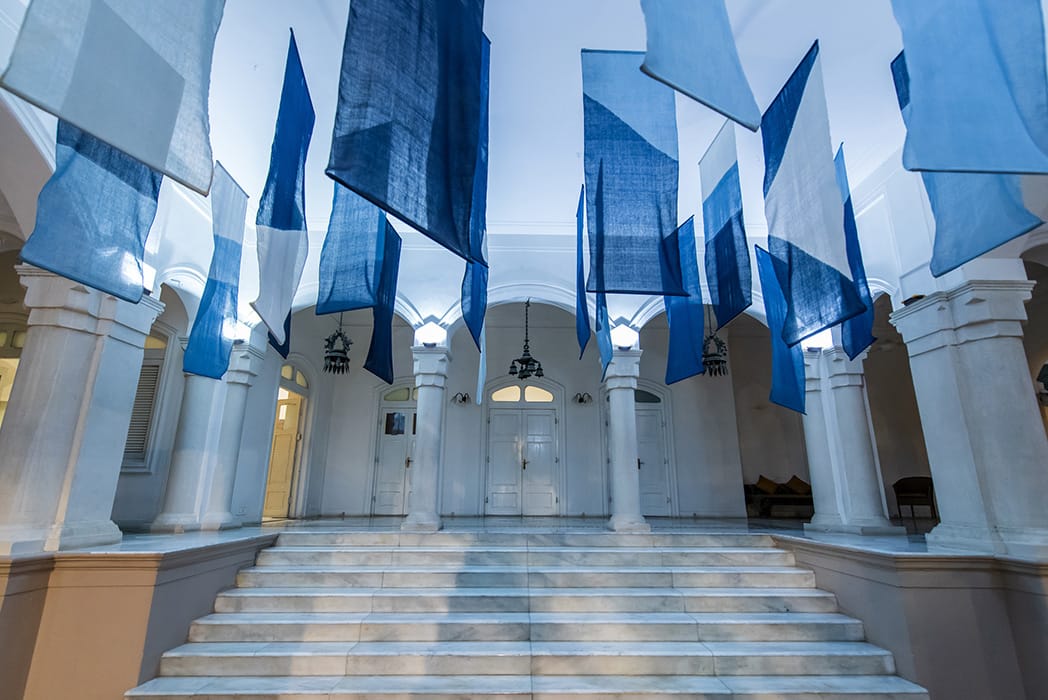
“Ciel divin” (Divine Sky), 2019, indigo-dyed fabric. In this work, fluttering indigo flags reveal a spectrum of shades reflecting the life cycle of the indigo vat. Fofana works with luxurious natural fabrics—such as hand-spun and hand-woven organic Malian cotton—using them as a canvas for a range of indigo hues, from the deepest blues to near-white tones. The installation features twelve distinct shades of indigo, ranging from the lightest, “Baga fu,” to the darkest, “Lomassa dunne,” echoing the deep tones of the sky.
Your blog post on Aboubakar Fofana is truly fascinating, highlighting the perfect blend of traditional craftsmanship and contemporary art.Thank you very much dear Veronique Auche 🩵🩵🩵🩵🩵


Your blog post on Aboubakar Fofana is truly fascinating, highlighting the perfect blend of traditional craftsmanship and contemporary art.Thank you very much dear Veronique Auche 🩵🩵🩵🩵🩵