Miles Aldridge (born 1964 in the UK) is a renowned fashion photographer and artist known for his vibrant, cinematic images. Trained in illustration at St. Matins School in London, and inspired by film noir and pop art, his work blends saturated colors and meticulous compositions to explore femininity, social norms, and fiction. His photographs have been published in Vogue Italia and The New Yorker, and exhibited in prestigious galleries.
Venus Etcetera (after Cabanel), 2021
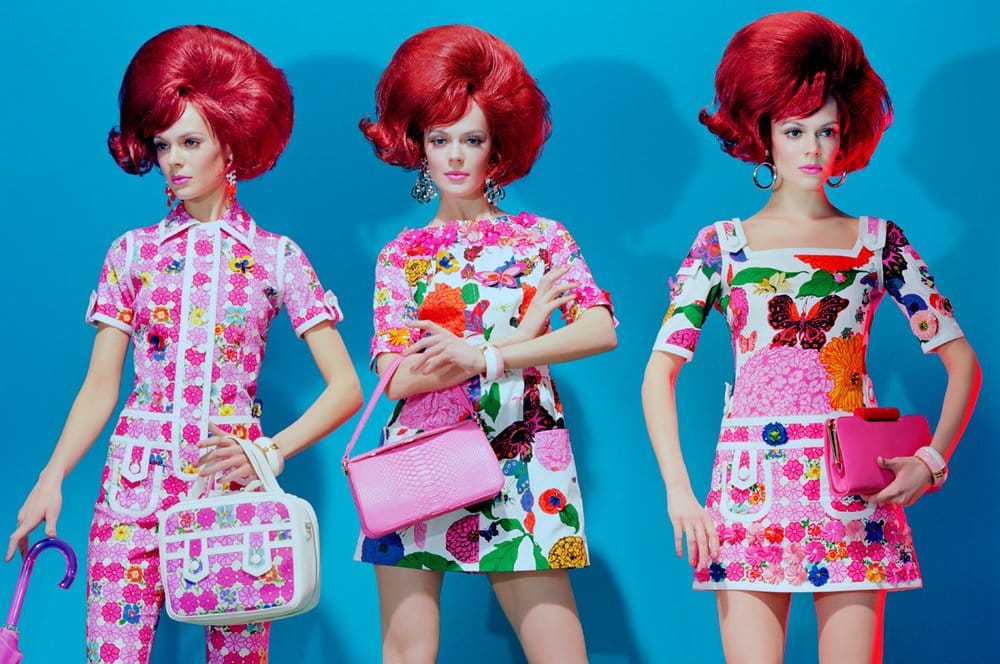
Mannequin Thriller #2, 2013
Miles Aldridge’s photography draws on cinematic glamour and a range of influences, including David Lynch, Fellini, Avedon and 1960s psychedelia.
Actress #6, 2012
Ecstasy #2, 2002
“I was sick of seeing all these pictures of beautiful women having fun in fashion magazines. It irritated me. It was the early 2000s, when I was starting out, and fashion was a kind of chocolate box world, totally fake and phony. If you read the newspapers, you knew that life and the world weren’t like that.” Miles Aldridge
The Rooms #2, 2011
Short Breaths #1, 2012
Short Breaths #5, 2012
“My father (illustrator Alan Aldridge) was a genius of psychedelia. He introduced me to a wide range of images at an early age – from pop art to religious imagery and comics. From my childhood, I also remembered the work of Michael English, and I wanted this photograph to look like one of his hyperrealistic, meticulous, airbrushed close-up paintings of objects such as Coke bottle caps.” Miles Aldridge
Actress #4, 2012
A Drop of Red #2, 2001
Mystical #3, 2018
Whether the subject is a girl in a car at night, a topless woman sitting at a banquet, or a constrained Stepford wife lighting a cigarette from a gas stove, these women possess distinct personalities that draw us into their unusual and perplexing lives. Although their worlds are very different, they share the same qualities of beauty, mystery, and intrigue.
Home Works #7, 2008
Immaculate #3, 2007
Maisie Williams, 2017
Miles Aldridge‘s work embodies the opera aperta, or open work; a term coined by Italian novelist and literary critic Umberto Eco. Open work considers that the artist, in this case the photographer, offers an element of multiplicity and plurality in art, emphasizing an interactive response between artist and viewer.
This is demonstrated when Miles states, “For me, the great joy of a great photograph is its mystery. So, in a way, I don’t really like to explain it. You want it to be an enigmatic image that intrigues people, makes them stare at it and question the idea of images. You’re supposed to look at them and wonder what’s going on in the image, and then, hopefully, in some way, even question your own world.
That’s what I aim for in my work.” To achieve such a conversation in his work, Miles prefers to “leave clues or symbols, allegorical references, anything they (the viewer) might try to interpret, but ultimately, I hope there will never be a single interpretation. He tries to influence people subliminally.”
3-D, 2010
Miles Aldridge
The parallels between attraction and aversion in Miles Aldridge’s work invite the viewer to engage in a mysterious world where beauty often meets an enigmatic and unsettling femininity. There is thus a predominant characteristic of ambiguity. This notion of ambiguity distinguishes him from his realist contemporaries in the way his images foster a unique interactive response between the photographs and the viewer.
Chromo Thriller #2, 2012
Five Girls in a Car #3, 2013
I Only Want You To Love Me #4, 2011
Miles Aldridge
The king of color and the most famous photographer in the glossy world, Miles Aldridge creates covers for Vogue, GQ, and The New Yorker, shoots the stars of Game of Thrones, and mocks glamour shots. His works often feature allusions to the paintings of Leonardo da Vinci and Sandro Botticelli, as well as images from the films of Federico Fellini, David Lynch, and Pedro Almodóvar. The highlight of the Aldridge retrospective exhibition in Moscow is a series of photographs taken with Maurizio Cattelan.
On the one hand, Aldridge’s work fits perfectly into the aesthetics of glossy magazines, as their visual characteristics align with society’s notions of beauty. On the other, they critique the ideals of the modern world and the system of which they are a part.
The Kiss, 2011
Venus Etcetera (after Titian), 2021
Doors #4, 2023
Never afraid to transgress the erotic or subvert a model into a questionable world, Miles Aldridge allows the viewer to experience a suspension of security, of the known, and of the natural.
When Miles began his career producing work for fashion magazines in the early 1990s, the photographs often seemed safe, presenting a world of happiness and beauty, wealth, and success: “They (the photographs) were devoid of any irony, implying that the world and everything in it was a happy place, but then, of course, you read the newspapers, you realize that’s not the case.”
Miles responded to this notion of “security” by gravitating toward “women who questioned this world they lived in, even if it was a world of extreme glamour and extreme success and having it all, but I liked the idea that they were questioning it.” “It started to create a kind of fictional woman who was a kind of heroine of my ideas in that she could express illness, unhappiness and questioning all the trappings of modern life and in that way I thought she was much more interesting than just a pretty girl.”
Doors #5, 2023
A Family Portrait #13, 2011
Doors #3, 2023
Red Marks #1, 2003
“I always wanted the women I photographed to be more like the people I knew: nervous, desperate, destructive, dangerous, demented. This image was part of a series called Red Marks, shot for Italian Vogue in 2003. I wanted to see how far I could go and get away with it.” Miles Aldridge
Doors #1, 2023
Doors #2, 2023
2013 was a turning point in Miles Aldridge‘s career. The launch of his portfolio, Carousel, was celebrated at the Château Marmont (on a hill in West Hollywood) during the first edition of Paris Photo LA.
A gathering of writers, celebrities, art professionals, and friends to celebrate the new project: Brett Easton Ellis, Courtney Love, Charlotte Rampling… and the haunting presence of Lady Gaga in the hotel, who expressed her appreciation and interest.
Carousel, along with the book I Only Want You to Love Me, is a selection of key Aldridge images, graphically presented by British designer Paul Neal.


So fun…
Merci Véronique !
je savais que tu aimerais
Très beau Véro merci.
Bisous tendresses ❤️❤️
merci Yves