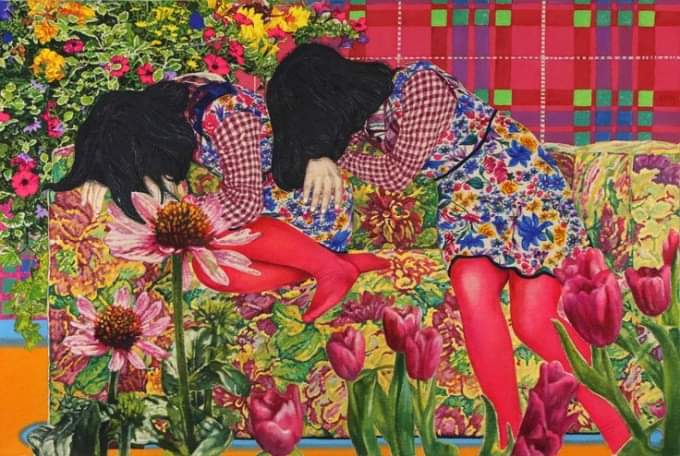
Naomi Okubo is one of those artists whose work fascinates. Fascinated by appearances, fashion and “the fear of the watchful gaze of others” – which probably explains why all the girls in her paintings hide their faces in one way or another.
Born in Tokyo in 1985, Naomi Okubo trained at Musashino Art University before moving to Brooklyn. In 2020, in the context of the pandemic, she returned to Japan. Her latest series, Wardian-Cased, produced in 2020, leads her to further develop the thinking that initially guided her work.
In her pictorial practice, Naomi Okubo develops beautiful, seductive images that mask darker themes linked to her adolescence and to larger problems and inconsistencies in society.
“I’ve always been careful about appearances. The ideas for my work come from an inferiority complex and my experiences as a teenager. That’s when everyone starts to think and worry about what other people think of their looks. When I changed my own image, people changed their attitude towards me,” Naomi explains. “They started to worry about me and our relationship improved. It made me aware of the power of fashion and my own fear of watchful eyes.”
Naomi‘s colorful, delightful compositions take us into a childlike or “adulescent” reverie. Here we find perhaps a few traits of post-war Japanese culture, which was built around an imaginary or naive style borrowed from the world of comics – mangas – that allowed us to mix fiction and reality. I’m not an acquired fan of this kind of style, but Naomi’s work is instinctively striking, with a palette of soft colors, sometimes accentuated, but always with grace and sensuality.
Okubo‘s paintings are populated by shy girls who don’t want to face the mirror, who hide behind books and flowers or simply stare at the ground and let their big black breasts block their view. They are fragile and aware, mysterious too, almost endearing.
In her own words, Naomi Okubo is interested in the complex relationship between Western society and the art of appearance, and thus fashion. If fashion has become so important, it’s because it is both a source of self-affirmation and, at the same time, a norm to be conformed to. So who shows up, or rather dares to show up, in their true light?
Should we see in the characters of “It cross the Mountain” a standardization of clothing as part of an excessive, consumerist debauchery? Underlined by overloaded backdrops? All that remains is the artist’s remarkable precision, which makes his compositions look like something out of the latest issue of Purple.
Naomi Okubo’s work also evokes a timeless Japan, with its mountains and cherry blossoms. This brings to mind the art of printmaking. But should we stay with this bucolic image, or decode other, less neutral information?
Social networks and the flood of images to which we are subjected reinforce our sense of social and behavioral norms, and fuel our fear of being judged when we deviate from them. They force us to accept our own personality, and lock us in a “social cage”.
Japanese artist Naomi Okubo‘s work is based on this observation and its consequences for our environment – both social and natural – and on a meticulous creative process.
“The context highlighted the contradictions inherent in our society. A lot of people, including me, realized that our social life is much more precious than we ever thought. I’m wondering how we can take each other in hand, get out of the utopia on which our society is based, and walk together towards a wilderness ? That’s the question I’m asking myself today,” says Naomi Okubo.
Trapped in an illusion. It was during her adolescence, when she was confronted with social judgment and the personal complexes it created, that the artist began to take an interest in the problem of image and the attitude that society expects of an individual. These codes of appearance and social behavior are de facto assimilated as norms, to the detriment of those who feel they don’t fit into this framework.
Questioning her own feelings, the artist depicts amorphous characters in an overloaded universe – notably of plants imported into human, artificial structures.
These young girls, whose style is inspired by the artist herself, hide their faces, avert their gaze, seek to escape the judgment of others, and are forced to remain shy and withdrawn. This dreamlike universe is an allegory of a society where personal inconsistencies and pain are masked by a deluge of “beauty”.
At the heart of Naomi Okubo‘s work lies a technical process that she systematically follows: “It starts with images gleaned from various media, then I create a digital collage incorporating a self-portrait. Then I use a projector to trace the contours. Even if some of my works look like real fabrics or digital prints, they’re all hand-painted. It’s very important to me. This process allows me to reconnect with reality,” explains the artist.
Removing our blinkers. For the Wardian-Cased project, the artist based her work on “Ward’s Crate”, the first portable terrarium model, invented by Dr. Nathaniel Bagshaw Ward around 1829. After discovering that the vegetation in his London garden of Wellclose Square was being affected by pollution at the height of the Industrial Revolution, Nathaniel Bagshaw Ward decided to have these watertight structures manufactured, enabling his ferns to develop more effectively.
Naomi Okubo found a parallel between this story and her current situation, as one summer evening, on a wildflower-covered rooftop in Brooklyn, she spotted huge water tanks on the horizon. “The juxtaposition of wildflowers, water tanks and the sunset over Manhattan almost looked like a science fiction scene, and it shocked me. At the same time, I realized that it illustrated the contradiction inherent in the world we live in,” she describes.
If ” the Wardian-Cased projec” has enabled a better understanding of our ecosystem, it has, like our society, made it difficult to “see the outside, the pollution, while we remain inside a bubble, breathing warm, humid air, surrounded by beautiful plants and butterflies. We can easily ignore what’s really going on outside, even if we convince ourselves that we’re living in a utopia, but we could simply be trapped there,” concludes the artist.
Naomi Okubo‘s work also evokes a timeless Japan, with its mountains and cherry blossoms. This brings to mind the art of printmaking. But should we stay with this bucolic image, or decode other, less neutral information?
In concluding the Wardian-cased series, Naomi Okubo says: “The context helped to highlight the contradictions inherent in our society. Many people, including myself, have realized that our social life is much more precious than we ever thought. I’m wondering how we can take each other in hand, get out of the utopia on which our society is based, and walk together towards a wilderness ? That’s the question I’m asking myself today.