An exceptional draughtsman and colourist, Raoul Dufy excelled in painting, engraving, lithography and ceramics.
Although he was influenced by Impressionism in his early years, before experimenting with Fauvism and Cézanne Cubism, Raoul Dufy succeeded in developing his own distinctive and easily recognisable style, making him one of the leading artists of the 20th century.
Bay of Angels, 1929
Le Havre, birthplace of great painters.
Born in Le Havre in 1877, Raoul Dufy was the eldest of nine children. Born into a modest family, the young boy interrupted his studies at the age of fourteen to work in a coffee importing business. But his father, who loved music, passed on his taste for art to several of his sons, including Raoul and his younger brother Jean (1888-1964), who also became a painter.
At the same time, Raoul Dufy attended evening classes at the Municipal School of Fine Arts in Le Havre. It was there that he met Othon Friesz (1879-1949), who would remain one of his most loyal friends.
Interior with Indian woman, 1930
1895-1900: Impressionist beginnings.
During his early years in Le Havre, Raoul Dufy acquired a certain mastery of drawing, which he continued to perfect.
He could not escape the influence of Eugène Boudin (1824-1898) from Honfleur and the Impressionist style that the landscapes and people of the region offered him. The beach at Sainte-Adresse was a favourite motif, featuring fishermen and strollers (La plage de Sainte-Adresse, 1904, oil on canvas, Centre Pompidou, Paris). From 1895 onwards, Dufy produced academic watercolours of landscapes in the surrounding area, as well as family portraits and self-portraits.
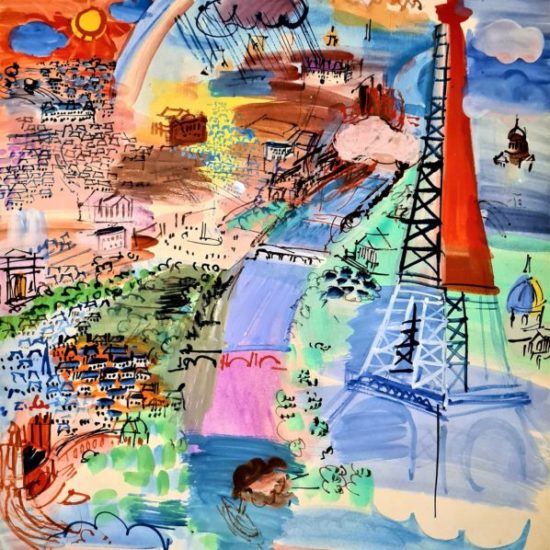
The Eiffel tower, 1935
1900-1908: Fauvism, an artistic shock.
In 1900, Raoul Dufy received a scholarship from the city of Le Havre to attend the École des Beaux-Arts in Paris. He attended the studio of the painter Léon Bonnat (1833-1922), where he met Friesz, with whom he shared a studio in Montmartre.
Between 1901 and 1904, Raoul Dufy continued to be influenced by the Impressionists – Camille Pissarro (1830-1903) and Claude Monet (1840-1926) in particular – but the Autumn Salon of 1905 came as a shock to the young painter. In fact, the fauvism of the artists Henri Matisse (1869-1954) and André Derain (1880-1954) triggered an artistic quest in Dufy that would lead him to develop a personal style.
During this period, Raoul Dufy produced simple works with uncluttered subjects and bright colours (old houses surrounding Honfleur harbor), 1906, oil on canvas).
The Nice Casino with chairs
1908: the temptation of Cézanne cubism.
In 1908, Dufy discovered Marseille and l’Estaque in the company of Georges Braque (1882-1963). The young artist was fascinated by Cézanne (1839-1906) and began to order his drawings through more geometric compositions.
In contact with Braque – who was to be at the origin of Cubism – Raoul Dufy simplified his forms, structured space and softened his colours (La grande baigneuse, 1914, oil on canvas, Musée d’Art Moderne André Malraux, Le Havre).
But cubism was not to the taste of the time, and the paintings sold very poorly. Out of economic necessity, Raoul Dufy turned to wood engraving from 1907 onwards, then continued his research work between 1909 and 1911. He illustrated many books, drawing his inspiration from popular art.
Le Grand Orchestre , ca. 1946, oil on canvas
1910: Dufy and fashion.
Seduced by Dufy’s imagination, the couturier Paul Poiret (1879-1944) asked him to design fabrics. So in 1910, Poiret and Dufy set up a fabric printing workshop called “La petite usine”. The artist was responsible for designing the motifs, engraving the wood for printing and studying the chemical techniques needed for printing. Little by little, Raoul Dufy introduced colour and softened his strokes.
In 1912, Dufy signed a contract with a Lyonnais silk company that allowed him to express his talent to the full. The artist continued this parallel activity until 1928.
Raoul Dufy.
From 1919: The search for his own touch.
Seeking to develop his own unique style, Raoul Dufy travelled to several countries from 1919 onwards – Italy, Sicily, Morocco – in search of new models. But it was in Provence that Raoul Dufy found his inspiration. He combined his extraordinary mastery of drawing with brilliant colours. His line freed itself from the constraints of cubism, allowing curves and arabesques to flourish (Les collines de Vence, around 1920, oil on canvas).
Café scene
Watercolour and gouache on paper by Raoul Dufy, made around 1934 – (Dimensions: 50.8 x 66.8 cm, sold for £50,000 at Sotheby’s London on 6 February 2014)
Raoul Dufy’s contribution to art history.
After experimenting with a number of styles – Impressionist, Fauvist, Cubist – Raoul Dufy succeeded in developing his own style. The essential characteristics of his style were in place by 1920.
Dufy’s compositions are first and foremost conceived through the painter’s characteristic line drawing. Plants, figures, symbols and curves emerge from his compositions as veritable sculptural elements. Drawn in pencil, Indian ink or a fine brush, they structure the scene and breathe life into it.
Combined with the drawing, the colour, spread out in broad flat tints or nervous streaks, soaks the form in the background and overflows, creating a colourful atmosphere of pure, radiant tones.
In this way, form and colour never completely coincide in Dufy’s compositions, making his paintings unique and recognisable.
Le clocher de l’église d’Harfleur ~ 1901-1903 ~ oil on canvas – 80 x 68 cm, MuMa Le Havre
In conclusion, Raoul Dufy began his career under the influence of the Impressionists, but soon felt the need to move in other directions. His meeting with Matisse acted as a revelation, giving him a glimpse of a new artistic and pictorial mechanism: “Fauvism”, which he experimented with between 1900 and 1905.
The painting shown above bears witness to this creative verve. While the choice of subject still links him to the Romantic tradition, his interest in medieval heritage and his taste for the picturesque, the view of the Gothic church allows the artist to play with the reflections of the water. While the effect of the shimmering water brought him closer to the Impressionists, the liveliness of the colours already heralded his later research, which would lead him to join the Fauves.
Nice, view of the Lesage Staircase, 1927, watercolour and pencil lines, pencil study on reverse, 65 x 50 cm. (Estimate: €20,000/30,000; sold for €126,880)


늘 고마워요. 🙂
thanks
The euphoria of colours… Raoul Dufyis such an exciting read!
thanks my dear friend
Interior with Indian woman me fait penser à Matisse.
oui