I deeply love autumn. Nature reveals its precious colors as it drifts toward the most mysterious slumber of all: winter. We revel in the shifting light, feast on vibrant fruits and vegetables, surrender to the poetry of the mist, and let ourselves be swept away along with the dancing leaves.
A source of inspiration for countless poets and artists, autumn is seen as a season of quiet happiness and creative melancholy. If your summer-loving soul suffers each year from the “long sobs of the violins of autumn” (Verlaine), here are some works rich in vibrant colors that will warm your heart.
The defining characteristics of autumn, the most classic and famous ones, which have become quintessential symbols of the season, include falling leaves, the prevalence of brown and reddish hues in nature, heavy rains, and the season’s characteristic fruits. All these distinctive elements have been immortalized by history’s greatest painters, sometimes with explicit reference to the autumn season itself. These artists skillfully captured the season’s melancholic poetry, creating some of the most unforgettable masterpieces in the history of art.
Autumn in New York by Kaoru Yamada
Sanmon Gate, Autumn Maple by Shufun Miyamoto, 1950. Woodblock print. One of the most important contemporary Japanese printmakers.
His works often depict romantic landscapes and serene natural scenes featuring pleasing color gradations; he loves to portray the seasons in their various shifting phases.
Illustration by Gaelle Boissonnard
And oh, how I love, oh season, how I love, your murmurs Fruit falling unplucked The wind and the forest weeping All their tears in autumn, leaf by leaf The leaves We tread upon A train Rolling by Life Flowing away
Guillaume Apollinaire, Alcools, 1913
“Autumn wind” by Pham Ánh, Vietnamese artist.
“Tree-lined Path in Autumn” 1902, Hans Andersen Brendekilde (Danish, 1857–1942)
“I love autumn; that melancholy season suits memories well.
When the trees are bare, when the twilight sky still holds the russet hue that gilds the withered grass, it is sweet to watch the fading of all that once burned within you.”
Gustave Flaubert (November)
“The Orchard” by Rosanna Tasker (British illustrator)
“Autumn” (c. 1900; oil on canvas, 101.5 cm x 58.5 cm) by John William Godward (1861–1922)
“Strained by the gale, the olives turn pale Like hoary wrestlers bowed by toil And, with the vine, their branches thin To fill our vats where summer lingers In red foam and the sun’s golden oil.
Soon, on the hearth’s invigorating pyre, Their rotted boughs will crumble: And like a ruby, panting fire, The grape will flush upon your fingers Through the glowing crystal of the cup.”
“The Autumn Fairy” (1919) by Ida Rentoul Outhwaite
I love the wayward gusts that shake the window all day long and tear the withered leaf from the mossy elm, whirling it near the pane along with thousands of others down the lane.
I love to see the trembling twig dancing until nightfall, and the sparrow on the cottage roof whose song makes one believe that spring had merely paused to flirt upon the laps of summer flowers.
John Clare, Autumn (excerpt)
“Wood Nymph” (1920; watercolor on wood; 30.5 x 21.6 cm) by Albert E. Smith
Behold! The pale autumn dawn Is faint upon the lawn That stretches out, a powdery white In the light of the frost
And now, from tree to tree The ghostly mist we see Hanging like a silver shroud To hallow everything.
It wraps the heavy air So strangely everywhere That I might almost fear This somber silence
Where no songbird sings And dream that magical creatures Powerful in hate or love Were hovering close above.
White as the fog and fair Drifting through the air In magic dances—terror Above my head.
Yet, they should know me too— Lover and faithful servant, One who has truly honored The mystic spell
Of earth’s most solemn hours When the ancient powers Of dryad, elf, or faun Or sprite
Have often shown their faces To me as I walked alone— Seashore or haunted marsh Or mountain glen
Therefore I shall not fear To roam the serene woods On this autumn day Far, very far away.
C. S. Lewis, Autumn Morning
Autumn-Colored Flowers, by Marc Chagall
“The dawn is less bright, the air less warm, the sky less pure, The long days have passed, the charming months are ending. Alas! Already the trees are turning yellow! And its mist, And fleeing summer is a friend departing.” Victor Hugo
“Autumn in the Center” by Petr Vikhor (Ukrainian artist) “My Dear Kharkiv” series, 2024, oil on paper, 15 x 20 cm.
Marion Alexandre Cantaloube, contemporary French artist
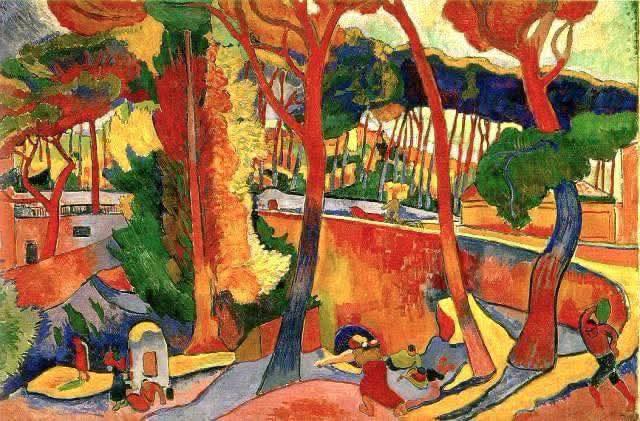
“L’estaque” by André Derain, (1905)
Still life by Paul Cézanne, “The Flower Vase”, 1896.
Olga Wissingen Florian (Austrian, 1844–1926), Autumn Leaves. Private collection.
“Young Girl with Brown Eyes in an Autumn Landscape”, 1920–1929, oil on cardboard.
Masa Feszty (1895–1979) was a Hungarian painter known for her portraits and figure studies. She often depicted women with serene expressions. I particularly love the sitter’s averted gaze in this portrait—framed by trees in golden autumn hues—which conveys a sense of intense emotion.
“Autumn” by Gordon Mortensen
“Autumn” by Natalie Salbieva
Original lithograph “Autumn” from the famous series of decorative panels The Seasons (1896) by the Czech artist Alphonse Mucha, born on July 24, 1860, in Ivančice and died on July 14, 1939, in Prague, an iconic figure of Art Nouveau.
“Profile of a Woman and Datura” (1899–1900)
An Art Nouveau brooch-pendant created by the French artist and jeweler René Lalique. Crafted from 18-karat gold, enamel, and peridot (or colored stones), and accented with fine gemstones, this piece combines a female profile with floral motifs of the datura (also known as “moonflower” or “devil’s weed”). It is a masterpiece of technical virtuosity that exemplifies René Lalique’s revolutionary approach to jewelry making. Rather than relying solely on large, sparkling diamonds to display wealth, Lalique combined precious and non-precious materials, selecting each element for its poetic color, texture, and luminosity. The *plique-à-jour* enamel technique creates a translucent, stained-glass effect, allowing light to pass directly through the petals. The enameling is distinguished by masterful, soft color transitions—blending opalescent greens with pale, milky whites—that capture the organic nature of a real flower. Lalique used the toxic nature of the datura (nicknamed “magician’s weed”) as a subtle metaphor for the *femme fatale*—a figure who is both alluring and dangerous. The piece is held in the collection of the Lalique Museum.
“Autumn Magic” by Tarn Ellis
“Autumn” (1912), oil on canvas by Franz Dvorak.
Franz Dvorak (1862–1927) was a Czech painter. The figure of Autumn bears a cornucopia filled with fruit and a wreath of sunflowers; she embodies the celebration of the harvest and flowers. In 1905, he returned to Prague and settled in a house with a studio by the river, where he lived until his death. During his time in the United States, he had discovered “new spirituality” movements and attempted to incorporate Eastern spirituality into his painting. These interests influenced his sister Helena, who translated several occult classics into Czech. For much of his life, he was more famous abroad than in his own country; his first major exhibition in Prague did not take place until 1907.
Wassily Kandinsky, “Autumn in Bavaria“, 1908, Centre Pompidou.
Red, orange, yellow… Through his signature vibrant palette, Kandinsky offers us his version of autumn, revitalizing the rather monotonous perception often associated with the season. Great masters of art history have painted autumn so magnificently that, looking out our windows today, we might be led to believe the season has lost its former beauty… Yet our autumns are no less splendid than those depicted by Monet, Van Gogh, Klimt, Müller-Kurzwelly, or Kandinsky! It simply takes a keen eye to notice. And if you need convincing, the yellow patches blossoming along the Bavarian street in Kandinsky’s painting serve as a reminder that—as Camus so beautifully put it—”autumn is a second spring when every leaf is a flower.”
Đặng Can depicts a woman dressed in a traditional white *áo dài* beneath a tree with red foliage.
Painting by Zhao Guojung
“Autumn Peacocks” by Colleen Parker.
Herbstmeer VII (Autumn Sea VII), created by the German artist Emil Nolde in 1910.
Joan Miró, “Women Armed with Sickles”, 1938.
Edvard Munch, “Elm Forest in Autumn”, 1919
“Autumn Leaves ” by Catrin Welz-Stein.
“Apple Tree with Red Fruit“, an oil painting created in 1902 by the French artist Paul-Élie Ranson.
The month of October from the famous “Les Mois” (The Months) calendar, created by the Franco-Swiss artist Eugène Grasset in 1896 for the renowned Parisian store La Belle Jardinière.


알려줘서 고맙고 반가워요.
늘 좋은 소식에 많은 도움이 되고 있어요.
늘 행복하시길 🙂
thanks